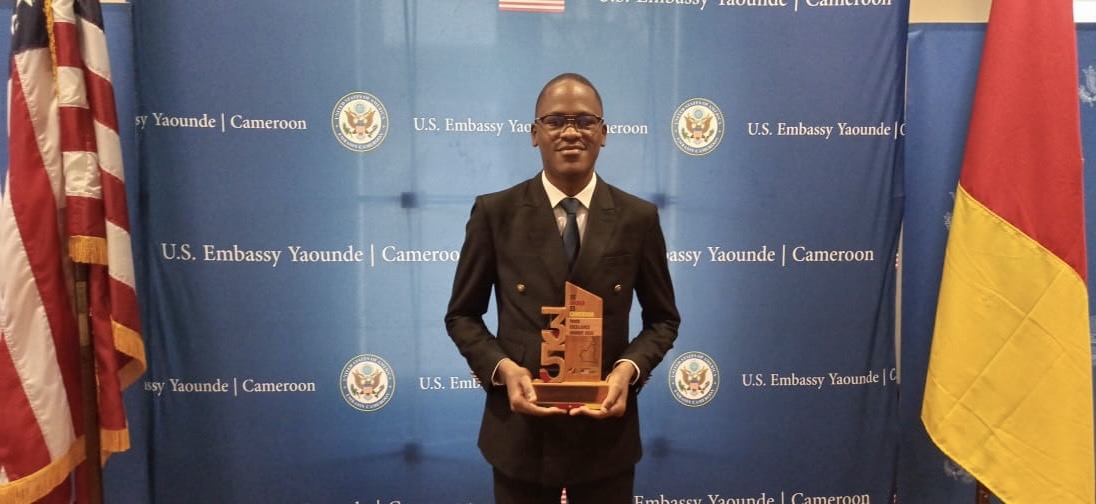
On Friday, September 4, 2026, I stood among thirty-five young Cameroonians being recognized for their leadership, innovation, and contribution to the country's future.
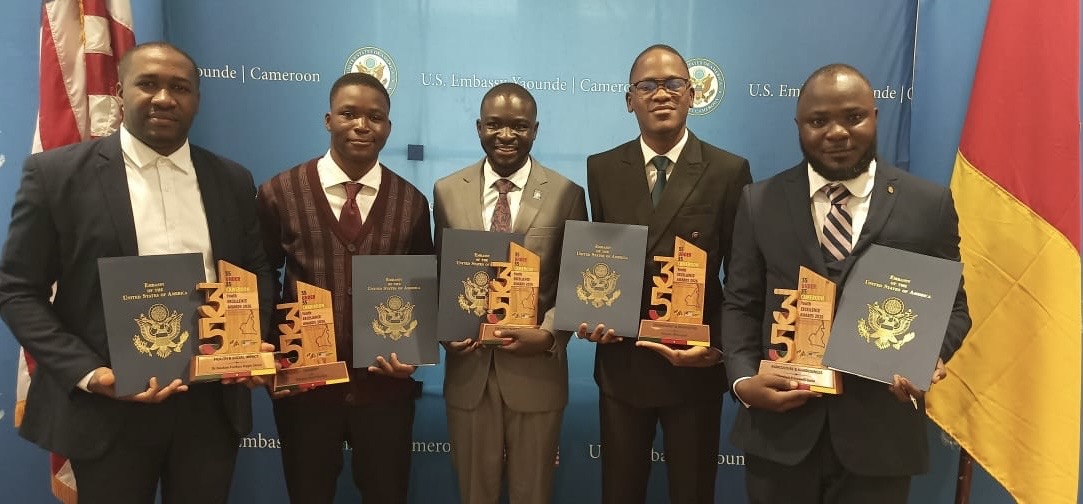
The ceremony was held at the U.S. Embassy in Yaoundé under the joint organization of the Cameroon Youth Awards (CYA) and the U.S. Embassy. The thirty-five honorees were selected from more than 1,200 national nominations, representing a broad cross-section of young Cameroonian talent across technology, finance, agriculture, public health, governance, disability advocacy, and the creative industries.
I was selected in the Technology & Innovation category.
The ceremony formed part of Freedom 250, the United States' commemoration of the 250th anniversary of its independence. It was an unusual and meaningful setting: a recognition of young Cameroonians taking place within an institution whose work is itself concerned with building relationships between countries and people.
Representatives of the U.S. Embassy and the United Nations Development Programme were present, including John G. Robinson, Chargé d'Affaires ad interim at the U.S. Embassy in Cameroon, and Martin Hart-Hansen, Deputy Resident Representative of UNDP Cameroon.
What recognition means
Awards are strange things. They compress years of work into a single moment: a name is called, a photograph is taken, a room applauds, and a line is added to a biography.
There is something meaningful in that moment. To be selected from more than 1,200 nominations is a significant acknowledgment of the work and the people represented by the cohort. It is also a reminder that there is considerable talent and ambition being developed by young Cameroonians, often far beyond the circles in which that work begins.
For me, however, the recognition is most meaningful when understood as both validation and responsibility.
Validation, because building in emerging markets can often mean working several steps ahead of the institutions and infrastructure required to recognize a problem. Much of the work happens quietly: research, experiments, technical iterations, regulatory questions, conversations, setbacks, and the slow construction of something that may only become visible once it works.
Responsibility, because recognition creates an obligation not to confuse visibility with achievement.
Recognition is useful only if it creates enough responsibility to make the next piece of work better.
The award does not change the scale of the problems I care about. If anything, it makes the distance still to travel more apparent.
The work behind it
Much of my recent work has centered on a simple question: how do we make capital and opportunity work better for people who have historically been poorly served by the systems allocating them?
That question led to AfriScore, where we are exploring how alternative data—including mobile-money activity—can help financial institutions make more informed and explainable credit decisions for people whose conventional financial histories are thin or nonexistent.
But the underlying ambition is larger than credit scoring. Credit is one part of a broader problem of financial infrastructure: reliable information, institutional trust, efficient capital allocation, and the systems that allow individuals and businesses to participate meaningfully in an economy.
That broader perspective is important to me. The objective is not simply to build another financial technology product. It is to understand and, where possible, improve the systems through which capital, information, and opportunity move.
The same principle informs my work beyond AfriScore. Across research, institutional work, and Linktion Futures, I am interested in the infrastructure that determines who gets access to opportunity—and what happens when that infrastructure is designed differently.
Recognition and responsibility
A young leadership award should not become a certificate of having already arrived. At its best, it is an invitation to take on more difficult problems.
Leadership, in this sense, is not simply about holding a title. It is about developing the capacity to create value, challenge assumptions, bring people together, and build things that continue to work beyond the person who started them.
That responsibility extends beyond individual achievement. The strongest thing a recognition can create is a network: people who can collaborate, challenge one another, open doors for others, and help build institutions that survive their founders.
Cameroon does not lack young people with ambition or ability. What remains harder is building the institutional conditions in which that ability can compound.
That is the part of leadership I find most compelling—not simply becoming successful within an existing system, but helping build better systems for the people who come next.
The 35 Under 35 recognition is therefore meaningful to me not only because of what it says about the work already done, but because of what it asks of the work that follows.
I am grateful for the recognition, for the people who nominated and supported me, and for the thirty-five young Cameroonians with whom I now share this chapter.
But the award is a marker, not a conclusion.