Delivered system · 2025
GEDA: electronic document management for CEMAC Representations
Gestion Électronique des Documents Administratifs
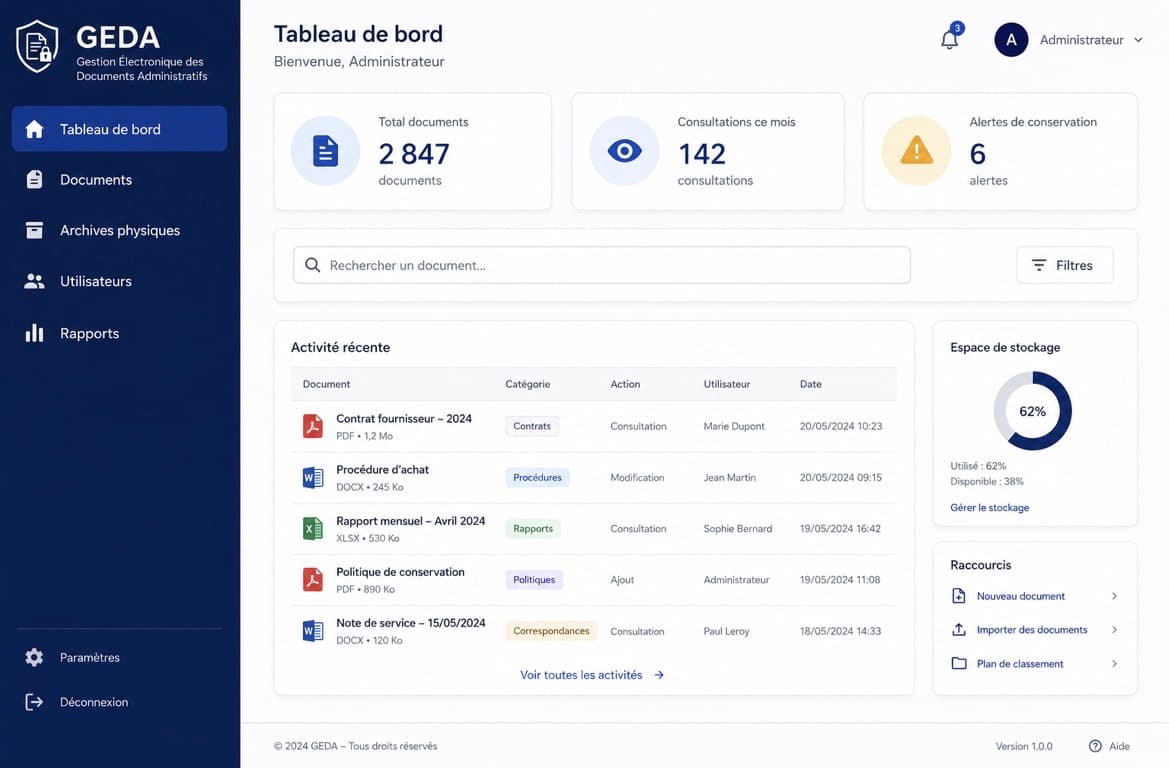
GEDA (Gestion Électronique des Documents Administratifs) is a self-hosted document management system that I designed, built and installed alone during my 2025 internship as Regulatory Affairs Assistant at the Representation of CEMAC in Cameroon. It now serves the Representations in Cameroon and Gabon, and it is the first platform shared across CEMAC Representations.
- Representations (Cameroon, Gabon)
- 2
- Users
- 16
- Documents
- 87,000+
- Average retrieval time
- About 2 seconds
- Build
- 2 weeks
- Installation on site
- 2 days
- Staff training
- 1 week
Role: sole builder. Design, development, on-site installation and staff training.
Context
Before GEDA, the Representation's document process was entirely manual and fragmented. Records lived in physical paper files and in scattered digital folders on individual computers and in personal email inboxes. Finding a specific document meant relying on human memory and long physical searches, which led to duplicated files, misplaced records and version confusion.
There was no central repository, so sensitive diplomatic and financial records had no standard access controls or traceability. The institution was exposed to data loss and unauthorised access, and its institutional memory was at risk every time staff changed.
What I built
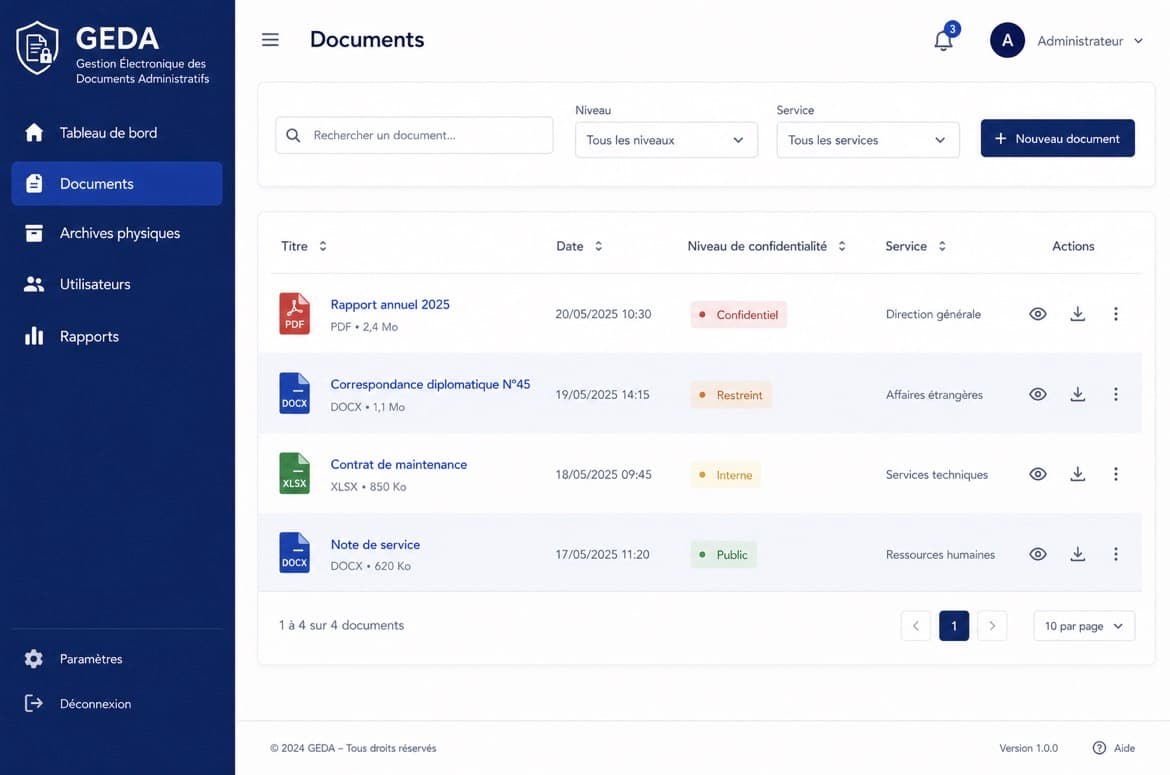
- A document library with titles, dates, confidentiality levels and services, sortable and filterable.
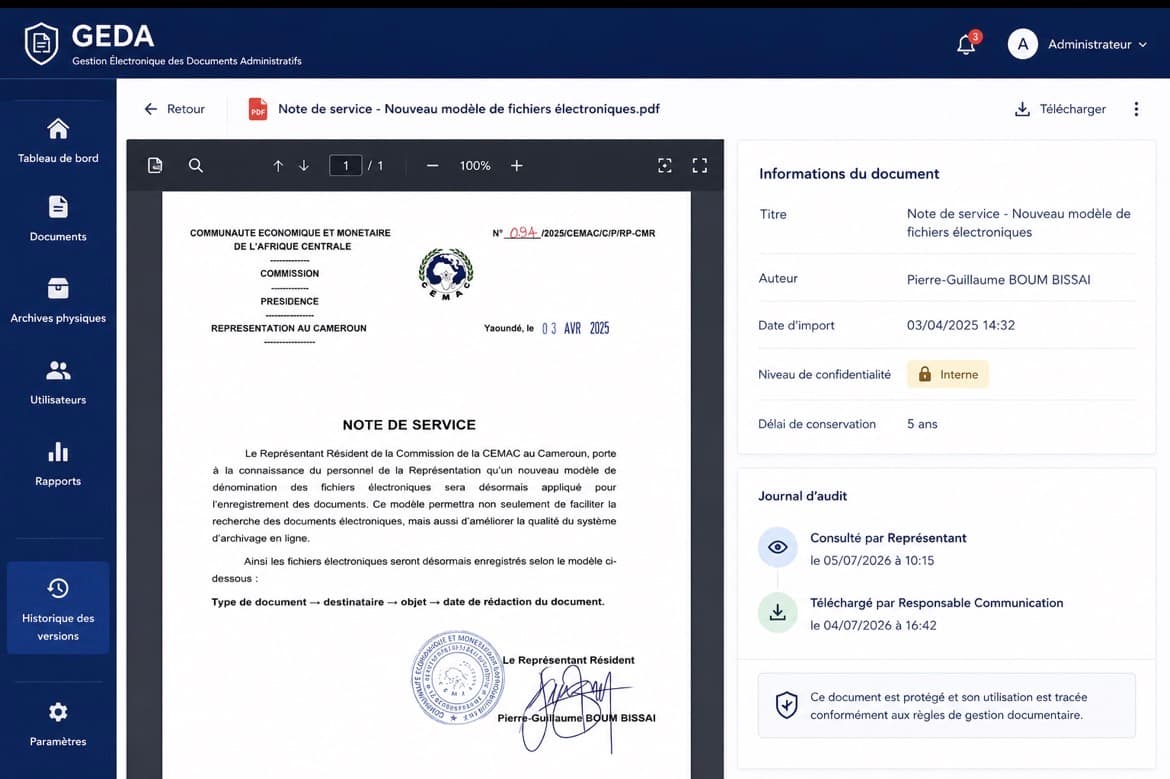
- Four confidentiality levels on every document: Confidential, Restricted, Internal and Public.
- Full-text search, including scanned documents through OCR, returning results in about two seconds on average.
- A section for physical archives, so paper records are managed alongside digital ones.
- A retention period on each document, with dashboard alerts when documents approach it.
- Version history for every document.
- User management with role-based access, and sign-in through OpenID Connect.
- A dashboard with totals, monthly consultations, retention alerts, recent activity and storage use.
Security and governance
- An append-only audit trail that records who viewed or downloaded each document, and when.
- Encryption with AES-256, and TLS 1.3 for traffic.
- Encrypted backups with rsync and GPG.
- Self-hosted: installed on site with Docker Compose on Ubuntu or Debian servers, so documents stay under the institution's control.
Rollout
I built GEDA in two weeks, installed it on site in two days, and trained the staff in one week. I was the sole builder, from design to installation and training.
It began at the Representation in Cameroon, with 7 users, and now also serves the Representation in Gabon, with 9 users. Together they hold more than 87,000 documents, combining the archive migrated at setup with documents added through daily use.
Outcome
Adoption was immediate. A retrieval task that used to take an afternoon now takes about two seconds on average, using the built-in full-text search.
Physical retrieval delays have all but disappeared, and the Representative now has real-time, append-only audit trails. A vulnerable manual process became a centralised, secure and efficient digital workflow.
Stack
Backend
- Rust
- Axum
- SQLx
- JWT
- OpenID Connect
Frontend
- React
- Next.js
- Tailwind CSS
- TanStack Query
Data and storage
- PostgreSQL
- MinIO
- rsync
- GPG
Search and OCR
- Meilisearch
- Tesseract OCR
Infrastructure
- Ubuntu Server / Debian
- Docker
- Docker Compose
Security
- AES-256
- TLS 1.3
Attestations
“The implementation of the GEDA system marks a decisive turning point for our Representation. We finally have a sovereign, secure tool perfectly adapted to the requirements of our diplomacy. Beyond simple document management, GEDA guarantees the continuity of our institutional memory against the test of time and staff turnover.”
“For a long time, the scattering of our archives posed a major risk to the institution. Charles was able to understand our constraints and design a tailor-made solution. GEDA now allows us to find information in seconds, with complete traceability. It is an essential investment that I recommend to any institution concerned about its security.”